12th East Shikoku JALT Conference
Professional Development Series: Supporting Young Practitioners
Sunday, June 17th (9:30-3:00)
Kochi University, Room 136
Click below on the ‘Continue reading’ link to view presentation schedule and abstracts.
Author Archives: japantown
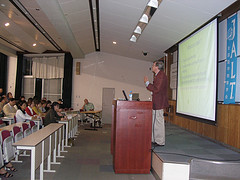
Professor Rod Ellis discusses Task-Based Language Teaching

We would like to extend extend a sincere and warm thank you to Professor Rod Ellis who journeyed all the way to Kochi to discuss his views on task-based language teaching. This East Shikoku JALT event attracted over 100 educators who traveled from Tokushima, Ehime, Kagawa, and Hiroshima. A video tape of Professor Ellis’ talk will be posted soon and his slide presentation is available in PowerPoint or HTML format.
You can also download his entire speech as a 54mb WMV file
or as a MP4 file in an AVI wrapper. The WMV file will only open with Windows Media Player. View more images of this event
Professor Rod Ellis, University of Auckland
Date: Wednesday, May 23rd, 2007
Start: 7:00 PM (19:00)
Title: Task-Based Teaching: Sorting out the Misunderstandings
Speaker: Professor Rod Ellis, University of Auckland
Description: This talk is in four parts. The first part will consider the
design of task-based courses and the methodology for implementing tasks in the classroom.
The second part will present my rationale for task-based language teaching (TBLT). I will argue that the development of the implicit knowledge of a second language that is required for effective communication is best achieved by engaging learners in performing tasks. That is, learners can develop their communicative competence (including linguistic competence) through performing tasks, especially if the performance of the task entails attention to linguistic form.
The third part of the talk will examine theoretical objections that have been levelled against TBLT and argue that these are based on fundamental misunderstandings of its principles and methodology. Sheen (1994) and Swan
(2005) have criticized TBLT on a number of grounds, including that there is no evidence to show that it works or works better than a more traditional form-focussed approach to language teaching. The
assumptions underlying their criticisms will be examined and a response provided.
The fourth part will address more substantial problems with implementing TBLT in school classrooms, especially those in foreign language contexts.
Again, I will suggest a number of possible solutions to these problems.
Rod Ellis profile:
Rod Ellis is currently Professor in the Department of Applied Language Studies and Linguistics, University of Auckland, where he teaches postgraduate courses on second language acquisition, individual differences in language learning and task-based teaching. His published work includes articles and books on second language acquisition, language teaching and teacher education. His books include Understanding Second Language Acquisition (BAAL Prize 1986) and The Study of Second Language Acquisition (Duke of Edinburgh prize 1995). More recently, Task-Based Learning and Teaching early (2003) and (with Gary Barkhuizen) Analyzing Learner Language in (2005), were published by Oxford University Press. He has also published several English language textbooks, including Impact Grammar (Pearson: Longman). He is currently editor of the journal Language Teaching Research. In addition to his current position in New Zealand, he has worked in schools in Spain and Zambia and in universities in the United Kingdom, Japan and the United States. He has also conducted numerous consultancies and seminars throughout the world.
Venue Location: Kochi University Asakura Campus, room 212
One-Day Member Fee: 500 yen
JALT Member Fee: free
City / Prefecture: Kochi / Kochi
East Shikoku JALT April Event on Extensive Reading
Guest Speaker: Rob Waring
Title: Why we should not avoid extensive reading in our classes
Date: Sunday, April 22
Location: Kochi Women’s University, Room 351
Time: 13:00-14:30
Abstract:
This session will explore the various components of any learning program that are needed for successful language learning to take place. Reading is probably the most important skill that we can give our learners. Unfortunately, many of our learners are still unable to read confidently and smoothly by the time they leave our high schools. This session will present an approach to reading that encourages students to read fluently and for enjoyment at the very earliest levels of language ability. This will include the use of graded readers and other student-centred reading materials.
Profile:
Dr. Rob Waring is Associate Professor at Notre Dame Seishin University in Okayama, Japan. He is an acknowledged expert in Extensive Reading and second language vocabulary acquisition. He has published over 40 articles and has lectured in 15 countries on foreign and second language acquisition. He has just published a set of graded readers for teenagers. He is a board member of the Extensive Reading Foundation. Rob was Co-Chair of JALT 2005.
Professional Development Workshop: Supporting Young Practitioners
The next meeting for the East Shikoku Chapter is on Sunday, January 28th, 2007 from 1:30 PM to 3:00 PM.
This will be the first of a two-part series of events aimed at supporting young teachers and researchers in our chapter who have limited experience in publishing and presenting.
The meeting is at Kochi Women’s University, Language Lab, 5-15 Eikokuji-cho, Kochi City..
Cost for non-JALT members: 500 yen; for JALT members: free
East Shikoku JALT, December event
Psychometrics in Applied Linguistics
Ian Isemonger
Ian Isemonger of Kochi Women’s University talked the group through the
methodology behind the creation of psychological instruments: constructions and
operationalizations. An intelligent discussion ensued.
Event Announcement
Psychometrics in Applied Linguistics
Ian Isemonger
In this presentation, Ian Isemonger, Associate Professor at Kochi Women’s University, will give a presentation entitled Psychometrics in Applied Linguistics. After a general survey of how psychometrics is relevant to applied linguistics, this presentation will focus on instruments that claim to measure various psychological constructs. These instruments are frequently suggested to teachers as a means of profiling students in the classroom so that they can assist those with particular problems or needs. This presentation will explain the psychometric theory behind such instruments, and methods for determining their validity, so as to enable teachers to make better choices of instrument.
Ian is a specialist in psychometrics and has recently been published in Studies in Second Language Acquisition (in press, March, 2007) where he has criticized Rod Ellis in a rebuttal to a major study of the psychometrics of implicit and explicit knowledge. He has also published in other leading international journals such as Educational and Psychological Measurement. Ian’s teaching background over 13 years in Asia includes posts at four universities in Thailand, Korea and Japan.
Place: Kochi Women’s University, Eikokuji Campus, Room 351, 3rd floor (signs will be posted). 5-15 Eikokuji-cho, Kochi City.
Date: Saturday, December 16th
Time: 1:00 – 2:30
Cost for one-day members: 500 yen; for JALT members: free
East Shikoku JALT & JALTCALL October Workshop
This workshop, held in conjunction with JALTCALL, featured three 45-minute hands on presentations and an electronic poster session. In the main presentations, Paul Daniels & Timothy Gutierrez – Delivering Digital Content through Moodle, showed how an open-source content management system can be utilized to support in-class language learning activities. Lawrie Hunter presented on Effective PowerPoint presentations, guiding his audience through techniques for effective use of PowerPoint in the language classroom. Hunter suggested useful tips for the design, content and use of this software. Davey Leslie, in his presentation, The website as narrative: scripting a site with a notepad and a cup of coffee, shared ideas for creating unique sites based on his experience as a professional website developer and language teacher.
In the poster session’s unique digital format, presenters were assigned a table with four notebook PCs with Internet access, digital video and still cameras. Presenters demonstrated digital course content, useful websites, student projects, and educational lessons, giving their audience hands-on time with their software and content. Posters were presented by Marcus Otlowski– Online learning sites, Sean Burgoine – Using mobile phones/digital cameras for storytelling, Michael Sharpe – Mobile blogs, Charlie Robertson – Use of video storyboarding, Paul Daniels and Tim Gutierrez – Moodle: Classroom Use, and Ian Isemonger– An online-refereed journal for students.

View more images here.
East Shikoku JALT & JALTCALL workshop: Teaching and Learning with Technology
Sunday, October 22, 2006, 3:00 to 5:00 PM.
K-Building, 3rd floor, LL Room
Kochi University of Technology, Tosayamada-cho, Kochi-ken
| KUT campus map |
KUT car access map |
I. Workshops
Paul Daniels & Timothy Gutierrez: Delivering digital content through Moodle
The free content management software called Moodle is looking to be the state of the art for some time to come in CALL. Learn how this easy-to-use system can put you in the IT driver’s seat.
Lawrie Hunter: Effective PowerPoint Presentations
PowerPoint is ubiquitous, much maligned, much misused. This sharing oriented presentation looks at the design, content and use. Power
up!
Davey Leslie: The Website as Narrative: Scripting a site with a
notepad and a cup of coffee. Who does what? And why? And then what happens? A
guided tour to creating unique sites by a professional developer / language
teacher.
II. Poster Sessions
Marcus Otlowski
Online Learning Sites
With the abundance of online English study sites it has become increasingly difficult for students to, not only find useful sites,
but be able to move around and use the activities found on them.
This presentation will introduce a number of websites that were
recommended by students in Department of International Studies at
Kochi University for their simplicity and usefulness. Participants will be able to access these websites and explore the online learning environment.
http://web.mac.com/motlowski/iWeb/University/Online%20English.html
Sean Burgoine
Using mobile phones/digital cameras for storytelling.
To make storytelling more structured for the narrator and more vivid for the listener, a series of still images can be used. By recreating a story and taking pictures at certain intervals, an aid that can compensate for linguistic limitations can be made. The necessary technology, being a personal computer and digital camera, should be at every students disposal.
Michael Sharpe
Mobile Blogs
This poster session will introduce a project that involves students using their
mobile phones to create mobile blogs or MoBlogs about their daily lifestyles.
Charlie Robertson
This poster presentation will demonstrate the use of Video Storyboarding as a creative means to narrative development based on sound grammar and logical thinking.
Timothy Gutierrez & Paul Daniels
Moodle: Classroom Use
Tim Gutierrez and Paul Daniels will focus on
how Moodle’s activities can be utilized to support in-class language learning activities.
East Shikoku Event: Teaching Young Learners: Issues in Elementary English Education.
This event, held in conjunction with the Naruto Education University’s Center for English Education at Elementary Schools, featured a workshop by Stan Pederson on Seven Steps to Success with Young Learners. Pederson guided a large group of primary school English teachers through his seven steps, emphasizing song, stories and physical movement all of which encourage self-expression. All of Pederson demonstration activities provided insight into what young learners enjoy and how they learn. The workshop concluded with Pederson noting the importance of the feedback loop in setting achievable goals and assessment standards, noting that assessment for young learners is an area much in need of research in the Japan context.
The event also featured two presentations on issues related to elementary school English. Hidenori Ogyu discussed perspective of the jhs teacher in his presentation Starting Junior High School: The Current Situation and what Teachers expect from Elementary School Education. Soukichi Yoshioka presented on Issues in Elementary School English Education from the Perspective of the JTE. The event concluded with a discussion session centering on the need for a better link between elementary and junior high school English education.
Global Issues in the EFL Classroom
| Professor Kip Cates from Tottori University gives a workshop on “Methods for Introducing Global Issues in the EFL Classroom” at Kochi University. | ![]() |
More
photos by Lawrie Hunter
If you have any suggestions for presentation themes or locations, please leave us a comment on our comments page.