Unknown's avatar

About japantown

Author

MyShare Mountain Retreat

IMGP6843

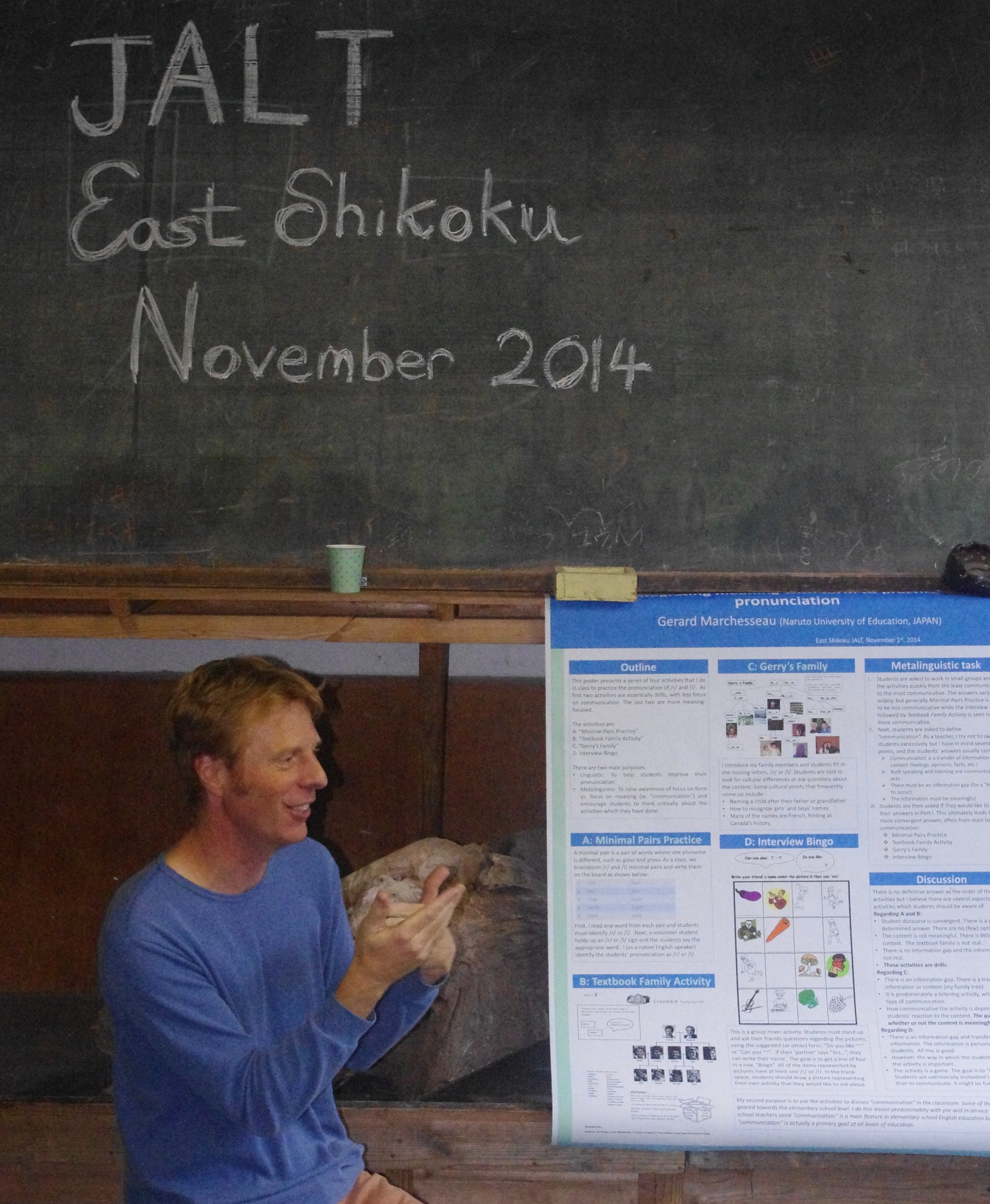
Date: November 1st, 2014
Time: 12:00 noon for lunch. Sessions will begin at 13:00.
Location: Maikawa, Konan, Kochi, in the old schoolhouse. Maikawa pin here: https://www.google.com/maps/d/edit?mid=zYyGqNZwwKEU.k7g4WthvKefg

Speakers:

  • Gerard Marchesseau, Integrating meaning with form to practice pronunciation
  • Maiko Ogasawara, Making Audience-friendly 
  • Paul Daniels, Implementing an ESP Project-based learning curriculum
  • Michael Sharpe, Science Challenge – a novel language-learning project
  • Von Holt, Language learning activities for children
  • Takahiro Ioroi, Using a Flip Instruction Model in Japan

Abstracts Continue reading

5th Annual Shikoku JALT Conference, May 10, 2014

Co-sponsored by East Shikoku JALT, Matsuyama JALT, and Oxford University Press.

Keynote & featured speakers:
Keynote address: Rob Waring – Notre Dame Seishin University OUP Featured Speaker: Sakae Onoda – Kanda University of Foreign Studies

Day, Time & Location: Saturday, May 10th (1:00 – 5:00), Ehime University, Matsuyama

Download PDF: 5th Annual Shikoku JALT Conference Program

Continue reading

Demotivators Within ELT Contexts, December 14, 2013

We are very pleased to welcome Keita Kikuchi who is a leading scholar in the study of demotivation in L2 learning. He has published a number of important empirical studies on demotivation among Japanese learners of English (e.g. Kikuchi 2009, Listening to our learners’ voices: What demotivates Japanese high school students? Language Teaching Research 13(4). Sakai and Kikuchi 2009, An analysis of demotivators in the EFL classroom. System 37).

Bio:
Keita Kikuchi is an Associate Professor at Kanagawa University, Japan. He holds an Ed.D. in TESOL from Temple University, Japan, and an MA in ESL from the University of Hawai’i at Manoa. His research interests include curriculum development and second language acquisition, especially individual differences.

Description of talk:
In my talk, I will introduce the idea of researching demotivation in English language learning contexts and present findings of studies conducted mainly in Japan. Then, I will discuss the future direction of demotivation studies.

In order to facilitate a fruitful discussion on this topic, I will use examples from my own studies (Kikuchi, 2009; Kikuchi and Sakai, 2009; Sakai and Kikuchi, 2009). By the end of the talk, I hope to have demonstrated that demotivators may vary in different situations. Finally, I would like to encourage a reflective group discussion regarding the variety of demotivators within ELT and within the audience’s own teaching contexts.

Date: December 14, 2013
Time: 5 – 7 PM  (followed by dinner).
Location: University of Kochi (Kochi Women’s University) LL room.
*** This event will be followed by our annual end of the year party. ***

Teaching Literature & Writing in Asia: Tales from Sri Lanka & Malaysia

Speakers: Dr. Senath Walter Perera and Dr. Carol Leon
Please join Dr. Walter Perera from Sri Lanka and Dr. Carol Leon from Malaysia for a discussion of issues that student-writers face in their respective multi-lingual outer circle contexts.
Date: Saturday, November 9
Time: 10:00 – 11:00
Place: Kochi University, Humanities Bldg, 5F, Enshu Room 1
Speaker profiles:
Dr. Senath Walter Perera is Senior Professor of English at the University of Peradeniya in Sri Lanka. He specializes in Sri Lankan writing in English with a focus on the Sri Lankan novel of expatriation. Perera also serves on the Gratiaen Trust which administers the Gratiaen Prize instituted by Michael Ondaatje to promote English creative writing in Sri Lanka. He has been Editor of The Sri Lanka Journal of the Humanities since 1996 and was recently awarded the Trinity College Kandy Prize for his contribution to Education.
Dr. Carol Leon is an Associate Professor in the Department of English at the University of Malaya. Her areas of expertise include post colonial literature, travel literature, and Malaysian children’s literature.

Donald Carroll revisits conversational analysis

Abstract
In 1975, just one year after Sacks, Schegloff, and Jefferson published their landmark paper, Irene Daden, then a master’s student in Applied Linguistics at UCLA, wrote a thesis with this intriguing title: Conversational analysis and its relevance to the teaching of English as a second language.  In the intervening decades conversation analysis (CA) has grown from an obscure offshoot of sociology into one of the most vibrant and active research paradigms within the field of second language education. Over the past dozen years, a mounting number of CA studies has explored the intricacies of second language talk, helped to chart pedagogic practices in the classroom, sought to illuminate novice-expert discourse identities, and even attempted to capture language learning as it happens in-situ.

Yet in the intervening decades since Daden wrote her thesis, there has been little progress in terms of applying CA to the teaching of English as a second language.  Only the barest few of the world’s language teachers have even heard of conversation analysis. At the largest conferences for language teachers, CA has had only a token presence.  Moreover, commercially published ESL teaching materials fail to offer a single CA-inspired textbook, and in fact, continue to present English models in stark conflict with the routinely observable patterns of interaction.  The purpose of this presentation is to revisit Daden’s original question:  What practical relevance does CA have for classroom ESL/EFL teachers? In short, how can hard-working language teachers benefit from Conversation Analysis?  During this talk, I’ll detail and demonstrate some of the ways that I have personally tried to apply CA to my own language teaching, in particular the teaching of conversation.

Bio
Dr. Donald Carroll has been a professor in Shikoku Gakuin University’s Department of Language and Culture since 1996.  Prior to that he taught applied linguistics and EFL/EAP/ESP in Mexico, the Sultanate of Oman, Kuwait, and Saudi Arabia.  He has a Ph.D. from the University of York (2006) and a BA and MA in Applied Linguistics from California State University, Fullerton (1980, 1984).  Don has also taught an Introduction to Conversation Analysis course for Temple University Japan’s MATESOL program at both the Tokyo and Osaka Campuses.

Date, time & location
Wed. Nov. 20th
6:15-7:30pm
Kagawa University
Education Campus
Room 423

REED: The Life and Works of Roy Kiyooka

Roy Kiyooka flyer– A Film by Fumiko Kiyooka

制作:2012年/カナダ 所要時間:94分 日本語字幕あり

Date: 6月18日(火)18 : 30 〜 20 : 30
Venue: 高知県立大学永国寺キャンパス LL教室, University of Kochi, South Building, 2F, LL

REED: The Life and Works of Roy Kiyooka follows the radical times in which the artist lived, from the Beat Era to the turmoil of the 60s and redress for Japanese Canadians in the 1980s. It is an extraordinary tribute to a great artist, showing a broad spectrum of his work while revealing the personal and social history that inspired him. The filmmaker, Fumiko Kiyooka, is screening this film throughout Japan during the month of June. She will present this film and field questions after the screening.
ロイ・キヨオカ(Roy Kenzie Kiyooka, 1926-1994)カナダの写真家、詩人、芸術家。 日系カナダ人二世。大阪万博ではカナダ館の彫刻を手がけた。母親は土佐の士族の娘 。
Presenter Bio:
Fumiko Kiyooka studied film and dance at Simon Fraser University and received her MFA in film production from the University of British Columbia. Her documentaries include: REED: The Life and Works of Roy Kiyooka, The Longed-for Knowing, The Return and a six-part series about Canadian Independent filmmaking called Through the Lens. Fumiko’s films are intense and personal. They deal with art, culture, history and social issues.
協力:East Shikoku JALT 全国語学教育学会東四国支部
共催:高知県立大学文化学部

Free to all participants

ESJALT Foreign Language Education Workshop 2013: Puzzling about classroom language learning: an Exploratory Practice approach

Date & Time:
Thursday, 5.23.2013
18:00~19:30

Place:
Univ. of Tokushima Josanjima campus
Faculty of IAS, Bldg. #1 Meeting Rm. #2

Title:
Puzzling about classroom language learning: an Exploratory Practice approach

Abstract:
In recent years, Exploratory Practice has developed as a form of ‘inclusive practitioner research’ (Allwright, 2001, 2009; Allwright & Hanks, 2009; Hanks, 2009, 2013; Miller, 2009). Arguing that working for understanding(s) should be put before problem-solving, EP includes teachers and learners as researchers of their own language learning lives. In this interactive workshop we will discuss the principles of Exploratory Practice: what is EP and why does it emphasize puzzlement as an approach?

Participants are invited to consider what puzzles them about their language teaching (and learning) lives. We will then discuss ways of investigating classroom language learning and teaching, using our normal pedagogic practices as tools.

Allwright, D. (2001, May 1999). Three major processes of teacher development and the design criteria for developing and using them. Paper presented at the 1st International Conference on Language Teacher Education. Research and Practice in Language Teacher Education: Voices from the Field, Minneapolis, USA.
Allwright, D. (2009). Inclusive Practitioner Research: Why we need it and what Exploratory Practice offers. In T. Yoshida, H. Imai, Y. Nakata, A. Tajino, O. Takeuchi & K. Tamai (Eds.), Researching Language Teaching and Learning: An integration of practice and theory (pp. 15-31). Bern: Peter Lang.
Allwright, D., & Hanks, J. (2009). The Developing Language Learner: An introduction to Exploratory Practice. Basingstoke: Palgrave Macmillan.
Hanks, J. (2009). Inclusivity and collegiality in Exploratory Practice. In T. Yoshida, H. Imai, Y. Nakata, A. Tajino, O. Takeuchi & K. Tamai (Eds.), Researching Language Teaching and Learning: An integration of practice and theory (pp. 33-55). Bern: Peter Lang.
Hanks, J. (2013). Inclusivity and trust in Exploratory Practice: A case study of principles in practice. In E. Tarone & D. Soneson (Eds.), Expanding our Horizons: Language teacher education in the 21st century. Minneapolis: CARLA.
Miller, I.K. (2009). ‘Puzzle-driven’ Language Teacher Development: The contribution of Exploratory Practice. In T. Yoshida, H. Imai, Y. Nakata, A. Tajino, O. Takeuchi & K. Tamai (Eds.), Researching Language Teaching and Learning: An integration of practice and theory (pp. 77-93). Bern: Peter Lang.

Bio:
Judith Hanks has more than twenty years of experience in teaching English as a Foreign Language, in Europe, Asia and the UK. She currently teaches in the School of Education, University of Leeds. Her research interests lie in the areas of practitioner research, and teacher/learner development. Judith is co-author of The Developing Language Learner: An Introduction to Exploratory Practice (Allwright & Hanks, 2009).

*For inquiries, contact Steve Fukuda at
stevefukuda110277@gmail.com

4th Annual Shikoku JALT Conference

Date and time: Saturday, May 11th (11:00 – 17:00), Economics/Law Campus, Kagawa University

Download the Conference Program.

Matsuyama JALT Featured Speaker:
Ian Isemonger – Kumamoto University (Doing Quantitative Research)

East Shikoku JALT Featured Speaker:
Chiaki Iwai – Hiroshima City University (Communications Strategies)

Oxford University Press Featured Speaker:
Junko Yamanaka – OUP author / Extensive Reading Foundation (Extensive Reading & Reading Strategies)

Short papers/presentations:
To be announced in early March

After the featured speaker talks, the latter part of the programme will include sessions for 30-minute presentations/short papers (20 minutes + 10 min Q&A). We invite presentation proposals from JALT members as well as non-members.

(CLOSED) The deadline for proposals is Friday, February 22nd, 2013. Presentation proposals will be vetted by the Conference committee. Decisions on presentation proposals will be sent out in mid to late March.

Please submit your proposal for a short paper to: shikokujalt@gmail.com

Submission Guidelines:
Presentation submissions should include the following information in the text of the email message:
Name: (please include any co-presenters along with the main speaker)
Affiliation:
Presentation title: (no longer than 60 characters/letters including spaces)
Abstract: (maximum: 150 words)
Teaching context: (eg. university, high school/jhs, primary school)
Research/Content area: (eg. Reading, Motivation, TBLT, Listening, Testing, CALL, Materials, etc.)
Equipment requests: (eg. projector, DVD)

Fees:
1. Any JALT member may attend the Conference free of charge
2. There is no presentation fee for JALT members with accepted proposals
3. One-day membership for non-members: 1000 yen
4. There will be a presentation fee of 2000 yen for accepted proposals from non-members (in addition to the one-day membership)
5. Co-presenter submissions are welcomed but the main speaker shall be responsible for any payment of presentation fees for non-member co-presenters one month prior to the Conference.

We hope you will consider sharing your language teaching research or practical classroom ideas at the 4th Shikoku JALT Conference at Kagawa University. Please inform your colleagues and friends about this Conference. The 2013 Shikoku JALT Conference is sure to have something of interest for everyone.

Darren Lingley & Gerardine McCrohan
Conference Co-Chairs
4th Annual Shikoku JALT Conference (2013)

Learning & Technology Event


Date: December 8th
Location: University of Kochi, Eikokuji Campus, CALL Lab
Time: 5:30 – 7:00
Fee: Free for JALT members & 500 yen for non-JALT members.
Description:
This Learning & Technology panel discussion will offer the opportunity for members from the audience to discuss problems and solutions to common educational technology issues with leading educational technology teachers from the Kochi area. Each panel member will briefly introduce a topic followed by discussion.

Panel Members
————————————————————–
1. Davey Leslie
Using Google Docs in a Collaborative Learning Writing Environment

While Google Docs is an effective tool for collaborative writing projects, its effectiveness is somewhat limited by the wide range of computer literacy that I’m finding in my classes, specifically at Kochi University’s EPIC program where “International Communication” major students often have very minimal computer literacy.
————————————————————–
2. Loren Waller
Challenges of Using Moodle to Encourage Discussion in Japanese and English-Language Literature Classes

Facilitating discussion in classes can be a difficult task for the instructor. A number of factors make it difficult for students to contribute ideas about difficult texts in class. Having students read and prepare their ideas in advance on an online class forum such as Moodle can motivate them to think in advance about some topics that interest them, contributing to the creation of a student-centered learning environment. I will share some of my experiences of using Moodle to facilitate discussion in Japanese literature classes conducted in both Japanese and English.
————————————————————–
3. Paul Daniels
Learner-centered verses teacher-directed classrooms- a wavering act.

Student-centered language activities, often involving the use of technology, are an essential ingredient for autonomous learning. While the rational for developing learner-centered activities is well documented, conflicting expectations between learners and teachers of the learning process can sometimes shroud the most visible path.
————————————————————–
4. Craig Delaney
Tech support for teachers

What types of support do teachers want or expect? What do teachers do when they have tech-related problems or require help using software or IT resources?
————————————————————–

Original Call for participation

Are you interested in sharing how you use technology to support student learning? We are currently looking for educators to submit short proposals for a ‘Digital Showcase’ for the event. The event will *not* feature formal presentations, but instead will allow time for teachers to informally discuss how technology is helping or hindering student learning. The focus should not be on the ‘wow’ effect, i.e. how a *new* technology can be used to do ‘this or that’ activity or project in the classroom, but rather on specific problems, tribulations, outcomes and/or concerns with using technology in education. We have all used technology to some extent, i.e. publishing learning content online or recording student presentations, and we have all most likely wondered at times if technology is helping or hampering the teaching/learning process. If you have used, are using, or are planning to use technology in the classroom and would like to join our discussion, please email Paul (daniels at kochi-tech.ac.jp) with a brief description of your topic for discussion by December 1st. Also, if you have any classroom activities/projects that you have completed in the past, please feel free to prepare a few slides/images to explain how technology has helped and/or hampered the teaching/learning process.