Unknown's avatar

About japantown

Author

Mapping for EFL (part II): Witting use of concept mapping for EFL

Speaker: Lawrie Hunter

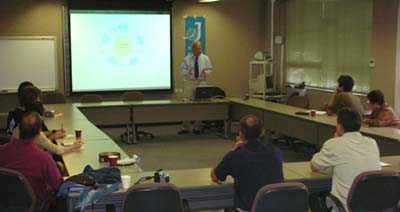
This workshop, part II of a 2-part series of workshops, begins with a brief review of part I, about the use of (1) Hunter’s infostructure maps and (2) Cmap Tools.
The KUT language lab is fully wired and internet connected, so bringing one’s own laptop is not necessary. In fact, given the LAN configuration, it’s best to use the KUT machines. Participants who missed workshop part I should familiarize themselves with Cmap Tools (download Cmap Tools free from cmap.ihmc.us/download/) and Hunter’s information structure maps (prereading at:
www.core.kochi-tech.ac.jp/hunter/professional/anchoring2/index.html
)
This workshop will demonstrate how to go beyond "I do mapping in my class" by means of various constraints and techniques that lead the learner to the use of specific language forms and patterns. This is germane: how many ‘constructivist’ tasks do you know of that actually lead the learner to specific language behaviors?
Making concept mapping (Novakian mapping) and/or information structure mapping part of the performance of constructivist task introduces low-language visual representation of the content of the learner’s creation. Concept maps can be subtly constrained in a number of ways to bring the learner to a limited range of information types or rhetorical moves, which will in turn necessitate the use of certain language structures and language features.
Map based constraints used in this workshop:
1. Output size constraint can be used to force summarization.
2. Complexity constraint can be used to force varying degrees of abstraction.
3. Rhetorical move constraint can be used to force a particular rhetorical form, e.g. argument.
The workshops are announced in map form at:
http://cmapspublic.ihmc.us/servlet/SBReadResourceServlet?rid=12249912795

Date and Time: Saturday, 24 January 2009 3:00pm – 5:00pm
Location: Kochi University of Technology, Language Lab, K building 3F
Fee for JALT members: Free
Fee for one-day members: 500 yen

Mapping for EFL (part I): Mapping tools and how-to hands-on workshop

Speaker: Lawrie Hunter
Date: Saturday, 6 December 2008
Start Time: 2:00 PM
Finish Time: 4:00PM
Location: Kochi Women’s University, Language Lab (in South Building),
5-15 Eikokuji-cho, Kochi City

This workshop, part I of a 2-part series of workshops, begins with a brief
overview of the variety of mapping types and mapping tools in use in education
today, followed by a hands-on workshop on the use of (1) Hunter’s infostructure
maps and (2) Cmap Tools.
Hunter’s infostructure maps are the underlying structure of "Critical Thinking"
(Greene & Hunter, Asahi Press 2002) and "Thinking in English" (Hunter, Cengage
2008). Prereading is available at

http://www.core.kochi-tech.ac.jp/hunter/professional/anchoring2/index.html.

Cmap Tools (http://cmap.ihmc.us) have taken
solid hold in science education in many countries, primarily for use in
representing learner’s and instructor’s perceptions of the nature of concepts,
and have a number of other appealing applications for education. The tools
themselves are free for download, and allow for free online storage and/or
sharing. There is a growing online collection of maps at the Cmap website.
 

Participants who wish to bring their own laptops are encouraged to do so.
Please be sure to have installed both PowerPoint and Cmap Tools (download Cmap
Tools free from
http://cmap.ihmc.us/download/
)

The workshops are announced in map form at this link.

Fee for JALT members: Free
Fee for one-day members: 500 yen
 

Workshop on Web 2.0 technologies in education

Kochi University of Technology, JALTCALL and JALT East Shikoku come together to host a workshop and symposium on Web2.0 technologies in education.

Date
: Saturday, Feb. 2, 2008

Location
: Kochi University of Technology, Tosayamada, Kochi, JAPAN
(3rd floor of K-building, located on the east side of campus, near the student cafeteria)
Time: 10:20 – 16:30

Speakers
: This event will host a number of educational technology professionals from Japan, America, and the U.K. Our key-note speaker, Dr. Michael Vallance (Hakodate Future University), will conduct a workshop on podcasts and the educational use of i-pods. Other invited speakers include Gordon Bateson(Kanazawa University), Takahiro Ioroi (Kochi Women’s University), and Mark Shrosbree (Tokai University). Other workshop topics will include eLearning systems, mobile learning and video editing. Today’s global learning environments have benefited tremendously from the emergence of web 2.0, the revolutionary second generation of web-based platforms and services. Web 2.0 technologies such as podcasts, mobile blogs and video sharing have the potential to greatly enable the promotion of interaction and social construction of knowledge both inside and outside the classroom. In Japan, mobile technology is ubiquitous; as a result there are a large number of possibilities for integrating the technology that students are already using in their personal lives into pedagogy and curriculum design. This colloquium, with its hands-on workshops, will allow participants to explore Web 2.0 technologies and their relationship with education and pedagogy, and to benefit from the practical experience of expert practitioners.

Continue reading

Asian Scholar Program

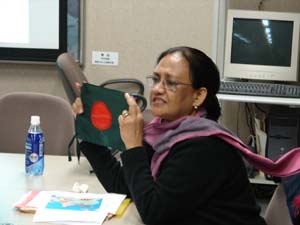
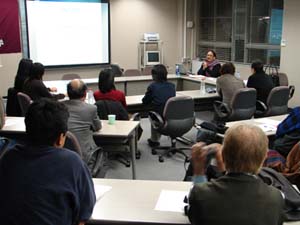
Professor Arifa Rahman talks on teacher reflection in EFL settings.

Rahman1
Rahman2

Event Announcement

East Shikoku JALT along with Kochi Women’s University Faculty of Cultural Studies is delighted to sponsor an event by this year’s Asian Scholar, Arifa Rahman, Professor of English Language & Teacher Education at Dhaka University, Bangladesh.

Speaker: Professor Arifa Rahman

rahman

Title: Developing a Reflective Approach in EFL Teaching

Content:
Since much of what happens in teaching remains unknown to the teacher, experience alone may be insufficient as a basis for development. Hence the role of reflection in a teacher education program is emphasized.
Besides teaching, analyzing and sharing ideas with peers and the supervisor, participants maintain a portfolio throughout the course to record experiences and reflections. With its on-going critical element, it is argued that reflective teaching can serve as a means of contributing to one’s professional development.

Profile:
Arifa has wide experience (25 years) in course design, materials development, teaching, administration and research, and has several publications to her credit. She has a PhD from the Institute of Education, University of London and is currently serving a second term as President of Bangladesh English Language Teachers Association (BELTA).

Date, Time and Place:
Friday evening, November 30th, 6:30-7:30 p.m. (Kochi Women’s University, 2nd floor seminar room)

**East Shikoku JALT Year-end party will be held just after the presentation (details to follow soon)